
| 일 | 월 | 화 | 수 | 목 | 금 | 토 |
|---|---|---|---|---|---|---|
| 1 | 2 | 3 | 4 | |||
| 5 | 6 | 7 | 8 | 9 | 10 | 11 |
| 12 | 13 | 14 | 15 | 16 | 17 | 18 |
| 19 | 20 | 21 | 22 | 23 | 24 | 25 |
| 26 | 27 | 28 | 29 | 30 |
- react onchnage 이벤트
- 생황영어패턴
- react 공부
- ~괜찮아
- 생활영어패턴
- react status
- i'm here to
- 수능영엉어족보
- 자기주도학습
- 수능영어독해
- react 이벤트 객체
- ~할꺼야
- react 이벤트 핸들러
- react 함수형 컴포넌트
- 영어공부
- 생활영어회화
- ~하려고해
- 수능영어지문학습
- react vite 사용
- ~하러 왔어
- 수능영어
- 혼공
- react #react 컴포넌트
- react 프로젝트 구조
- react 이벤트 처리
- react onsubmit 이벤트
- react 클래스형 컴포넌트
- 영어문법공부
- 2025수능영어지문
- react 데이터 바인딩
- Today
- Total
Marianne's Playground
[2025 수능 영어 독해] 21 문제 지문 학습 본문
친구들~~ 공부하느라 힘들죠~~~
영어 독해 어렵지 않아요!! 차근차근 분석해 봅시다!!
하루에 한개씩 도장깨기 해보자규~ 화이팅 :)
1️⃣ 단어 정리 (어려운 단어 & 뜻 & 예문)
| symbolically | 상징적으로 | The dove is symbolically used to represent peace. → 비둘기는 상징적으로 평화를 나타내는 데 사용된다. |
| draftsmanship | 제도 기술, 설계 능력 | Good draftsmanship is essential for an architect. → 좋은 제도 기술은 건축가에게 필수적이다. |
| aspiring | 포부를 가진, 열망하는 | An aspiring artist must work hard to succeed. → 예술가를 꿈꾸는 사람은 성공을 위해 열심히 노력해야 한다. |
| curriculum | 교육과정, 커리큘럼 | The school follows a modern curriculum. → 그 학교는 현대적인 교육과정을 따른다. |
| scholarship | 학문, 학식 | His scholarship in history is impressive. → 그의 역사에 대한 학식은 인상적이다. |
| correspond to | ~에 상응하다, 부합하다 | His words do not correspond to his actions. → 그의 말은 행동과 부합하지 않는다. |
| substance | 실체, 본질 | Don’t be fooled by appearances; look for the substance. → 겉모습에 속지 말고 본질을 봐라. |
2️⃣ 지문
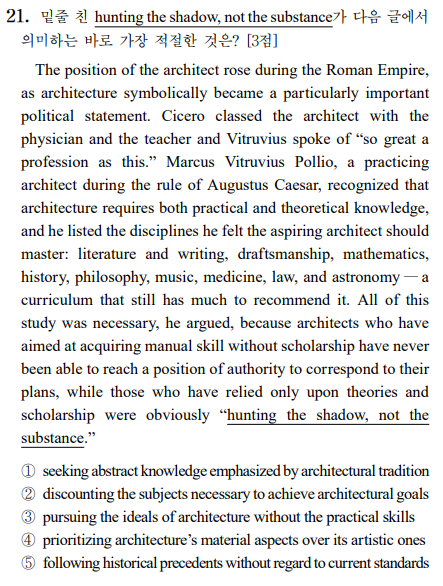
"The position of the architect rose during the Roman Empire, as architecture symbolically became a particularly important political statement. Cicero classed the architect with the physician and the teacher and Vitruvius spoke of “so great a profession as this.” Marcus Vitruvius Pollio, a practicing architect during the rule of Augustus Caesar, recognized that architecture requires both practical and theoretical knowledge, and he listed the disciplines he felt the aspiring architect should master: literature and writing, draftsmanship, mathematics, history, philosophy, music, medicine, law, and astronomy ― a curriculum that still has much to recommend it. All of this study was necessary, he argued, because architects who have aimed at acquiring manual skill without scholarship have never been able to reach a position of authority to correspond to their plans, while those who have relied only upon theories and scholarship were obviously “hunting the shadow, not the substance.”"
3️⃣ 문장 구조 & 구문 분석
🔹 전체 구조 설명:
- 이 문장은 로마 제국 시대 건축가의 사회적 지위 상승과 건축가에게 요구된 다양한 능력, 실무와 학문을 겸비해야 진정한 건축가가 될 수 있다는 주장을 담고 있어.
- 중심 문법 구조는 SVO, 명사절(that절), 관계대명사절, 분사구문, 인용 등으로 이루어진 복합문이야.
🔸 세부 구문 분석
- The position of the architect rose during the Roman Empire, as architecture symbolically became a particularly important political statement.
- 구조: 주어 + 동사 + 부사절 (as절)
- 해석: 로마 제국 시기, 건축이 상징적으로 특히 중요한 정치적 표현 수단이 되면서, 건축가의 지위는 상승했다.
- Cicero classed the architect with the physician and the teacher and Vitruvius spoke of “so great a profession as this.”
- 구조: SVO + and + SVO (두 동등한 문장 연결)
- 해석: 키케로는 건축가를 의사 및 교사와 같은 반열에 두었고, 비트루비우스는 **‘이처럼 위대한 직업’**이라고 말했다.
- Marcus Vitruvius Pollio, a practicing architect during the rule of Augustus Caesar, recognized that architecture requires both practical and theoretical knowledge,
- 구조: 주어 + 삽입구 + 동사 + that절(명사절)
- 해석: 아우구스투스 시저 통치 시기의 실무 건축가였던 마르쿠스 비트루비우스 폴리오는 건축이 실용적 지식과 이론적 지식을 모두 필요로 한다는 것을 인식했다.
- and he listed the disciplines he felt the aspiring architect should master: literature and writing, draftsmanship, mathematics, history, philosophy, music, medicine, law, and astronomy ― a curriculum that still has much to recommend it.
- 구조: SVO + 관계대명사절 + 삽입구
- 해석: 그는 건축가를 꿈꾸는 사람이 익혀야 한다고 생각한 학문들을 나열했는데, 그 교육과정은 지금 봐도 추천할 만한 가치가 크다.
- All of this study was necessary, he argued, because architects who have aimed at acquiring manual skill without scholarship have never been able to reach a position of authority to correspond to their plans,
- 구조: SVO + because절 + 관계대명사절
- 해석: 그는 말하길, 이 모든 학문은 반드시 필요하다, 왜냐하면 학문 없이 기술만 익히려 한 건축가들은 자기 설계에 걸맞은 권위를 결코 얻지 못했기 때문이다.
- while those who have relied only upon theories and scholarship were obviously “hunting the shadow, not the substance.”
- 구조: while절 (대조)
- 해석: 반면에 이론과 학문에만 의존한 사람들은 명백히 **“실체가 아닌 그림자를 좇는 것”**이었다.
🔹 전체 해석 (직역 + 의역)
- 직역: 로마 제국 동안, 건축이 상징적으로 특히 중요한 정치적 표현 수단이 되면서 건축가의 지위는 상승했다. 키케로는 건축가를 의사 및 교사와 동등하게 보았고, 비트루비우스는 “이토록 위대한 직업”이라고 말했다. 아우구스투스 황제 시절의 실무 건축가인 마르쿠스 비트루비우스 폴리오는, 건축은 실용적 지식과 이론적 지식을 모두 요구한다고 인식했다. 그는 건축가 지망생이 익혀야 한다고 생각한 학문들을 나열했는데, 그것은 지금 봐도 여전히 추천할 만한 교육과정이다. 그는, 학문 없이 수작업 기술만 익히려는 건축가는 자신의 설계에 걸맞은 권위 있는 위치에 도달한 적이 없고, 이론과 학문에만 의존한 사람은 실체가 아닌 그림자를 쫓는 것이라고 주장했다.
- 의역: 로마 제국 시기 건축은 단순한 기술이 아닌 정치적인 상징으로 부상했고, 건축가의 사회적 지위도 크게 높아졌어. 당시에는 건축가가 다양한 학문을 익혀야 한다고 여겨졌고, 단순 기술자나 학문만 아는 사람으로는 진정한 권위를 가질 수 없다는 점을 강조하고 있어.
4️⃣ 주요 빈출 구문 정리
- aim at ~ing → ~하는 것을 목표로 하다
- 예: She aims at becoming a lawyer.
→ 그녀는 변호사가 되는 것을 목표로 하고 있다.
- 예: She aims at becoming a lawyer.
- not A but B → A가 아니라 B
- 예: He was hunting not the truth but a fantasy.
→ 그는 진실이 아니라 환상을 좇고 있었다.
- 예: He was hunting not the truth but a fantasy.
5️⃣ 비슷한 문장 구조 예문
- The role of scientists gained prestige as scientific discoveries became central to national progress.
→ 과학적 발견이 국가 발전의 핵심이 되면서, 과학자의 역할은 위상을 얻게 되었다. - He argued that true leadership requires not only authority but also empathy and wisdom.
→ 그는 진정한 리더십은 권위뿐 아니라 공감과 지혜도 필요하다고 주장했다. - Those who focus only on memorization without understanding rarely succeed in complex tasks.
→ 이해 없이 암기만 하는 사람들은 복잡한 과제에서 좀처럼 성공하지 못한다.
🔍 문맥 다시 보기:
"...architects who have aimed at acquiring manual skill without scholarship have never been able to reach a position of authority...
while those who have relied only upon theories and scholarship were obviously “hunting the shadow, not the substance.”
➡️ 여기서 말하는 “그림자(shadow)”는 실제 건축 능력이 없는 이론만 파고드는 태도를 의미하고,
➡️ “실체(substance)”는 진짜 실력, 즉 실무 능력과 학문의 조화를 갖춘 진짜 건축가를 의미해.
🔑 핵심 해석:
이론이나 학문에만 의존하는 건축가는 그림자만 쫓는 것이고,
실체 있는 건축가가 되려면 실용 능력도 함께 갖춰야 한다.
보기를 하나씩 살펴보자:
| ① seeking abstract knowledge emphasized by architectural tradition | 건축 전통에서 강조되는 추상적 지식 추구 | ❌ 틀렸어. 여기서 전통이 강조되지 않았고, 추상적 지식이 목적이라는 점도 강조되지 않음 |
| ② discounting the subjects necessary to achieve architectural goals | 건축 목표 달성에 필요한 과목들을 무시함 | ❌ 반대야. 이건 학문을 무시하는 쪽인데, 여기선 이론만 파는 걸 말하고 있음 |
| ③ pursuing the ideals of architecture without the practical skills | 실용 능력 없이 건축의 이상만 추구함 | ✅ 정답! 바로 이거야! 이론만 쫓는 태도 = 실체 없는 이상만 추구한다는 말이니까! |
| ④ prioritizing architecture’s material aspects over its artistic ones | 건축의 물질적 측면을 예술적 측면보다 중시함 | ❌ 문맥과 무관함. 이론 vs 실무 얘기이지, 예술 vs 물질이 아님 |
| ⑤ following historical precedents without regard to current standards | 현재 기준은 무시하고 과거 사례만 따름 | ❌ 문맥에 언급되지 않음. 과거-현재 대립 구도 아님 |
✅ 정답: ③ pursuing the ideals of architecture without the practical skills
→ 실용 능력 없이 건축의 이상만 추구하는 것
'영어공부 > 수능영어공부' 카테고리의 다른 글
| [2025 수능 영어 독해] 23 문제 지문 학습 (0) | 2025.04.15 |
|---|---|
| [2025 수능 영어 독해] 22 문제 지문 학습 (0) | 2025.04.12 |
| [2025 수능 영어 독해] 20 문제 지문 학습 (0) | 2025.04.11 |
| [2025 수능 영어 독해] 19 문제 지문 학습 (0) | 2025.04.11 |
| [2025 수능 영어 독해] 18 문제 지문 학습 (2) | 2025.04.11 |


